

THE SHIELD REPORT
Deep technical EMI shielding intelligence
Issue #1 · Thursday, January 1, 2026 · 5 min read
By POCONS USA — EMI shields + components. Korea → Vietnam → San Diego.
The Signal
💡 One Thing
Samsung just committed $73 billion to semiconductors in 2026 — with advanced packaging as a named pillar. Every one of those HBM4 stacks, every chiplet interposer, every 2.5D package will need EMI containment. The shielding supply chain that serves AI silicon isn't ready for what's coming.
Regulatory Radar
- •
CISPR 25 Ed. 5 — Extended frequency range under review: The IEC/CISPR subcommittee D working group is drafting an amendment to extend automotive component emission limits to 6 GHz (currently 2.5 GHz). This directly addresses V2X, 5G-NR sidelink, and UWB radar interference. If your automotive shield was designed for 2.5 GHz max, start rethinking aperture sizing now.
- •
EU Radio Equipment Directive — cybersecurity requirements effective August 2026: RED Article 3.3(d/e/f) mandates network protection and data privacy features in all wireless-connected devices sold in the EU. The hardware implication: devices failing EMC pre-compliance due to poor shielding won't survive the extended certification timeline.
- •
Strait of Hormuz shipping disruptions: The US-Iran conflict continues to disrupt Persian Gulf shipping routes, adding 2–3 weeks to raw material lead times for nickel and tin sourced through Southeast Asian smelters. Factor this into your procurement planning through at least Q3.
Design Corner: Compartmentalized Shielding for Mixed-Signal Automotive ECUs
The problem: Modern automotive ECUs combine power management, CAN/LIN transceivers, microcontrollers, and RF front-ends on a single PCB. A switching regulator operating at 2 MHz generates harmonics that land directly in the GPS L1 band (1575.42 MHz) and the 2.4 GHz ISM band used by BLE key fobs. A single full-board shield can't solve this — you need internal compartments.
The approach: Use a two-piece board-level shield with internal divider walls to create isolated RF zones:
- • Material: Tin-plated cold-rolled steel, 0.15 mm. Cost-effective, solderable, and provides 40–55 dB SE from 100 MHz to 3 GHz when properly grounded.
- • Compartment sizing: Isolate the switching power section from the RF/analog section. The divider wall needs its own continuous ground contact — a floating wall is worse than no wall.
- • Critical dimension: Divider wall height must match the shield lid within ±0.1 mm. Any gap between divider and lid creates a slot radiator at exactly the frequencies you're trying to suppress.
- • Ground ring: 0.8 mm pads on 2.5 mm centers around the full perimeter AND along the divider.
Try this: Before layout, map your noise sources and victims on a block diagram. Draw the divider line where the switching regulator's 5th harmonic crosses your most sensitive receiver's IF frequency. That's your compartment boundary.
Metal Watch
| Metal | Price | Change | Outlook |
|---|---|---|---|
| Copper (Cu) | $12,230/t | ↑ 0.2% | Rebounding from Q1 correction |
| Tin (Sn) | $46,750/t | → flat | Stabilized after 13% Q1 drop |
| Nickel (Ni) | $17,110/t | ↓ 0.9% | Indonesia export tax looming |
Shield lead times: 4–6 weeks (standard) · 2–3 weeks (expedite)
What it means: Copper is stabilizing after the Q1 correction. Tin bottomed out — solder costs should hold steady. Nickel is the one to watch: Indonesia's export tax would structurally raise the floor for nickel-bearing shield alloys. If you spec nickel-silver shields, consider locking pricing through year-end.
Industry Signal
- •
Hyundai recalls 100,000+ Kona EVs for BMS software update. Battery management systems are increasingly sensitive to conducted EMI from adjacent power electronics. Every BMS recall is a reminder that EMC testing at the component level isn't optional — it's warranty protection.
- •
EMI shielding coatings market undergoing "structural transformation." Coatings are gaining ground in low-SE applications (IoT, wearables), but stamped metal shields remain the standard for anything above 25 dB — automotive ADAS, 5G small cells, medical imaging. Know where coatings work and where they don't.
Korean Electronics Intel
What's happening in Korea's electronics ecosystem — and why US engineers should care.
- •
Samsung's $73B semiconductor capex names advanced packaging as core pillar. HBM4 memory uses 12-high die stacks with through-silicon vias (TSVs) that create new EMI pathways between layers. If you're designing AI inference boards that consume HBM4, your memory's EMI signature is being set at the package level before it reaches your PCB. Source: Chosunbiz
- •
SK hynix explores tighter DRAM die gaps in HBM4 packaging. Tighter gaps mean higher coupling between die layers — and more aggressive EMI containment at the package and board level. Board-level shields over HBM4 modules may need to account for package-level emissions that didn't exist in HBM3E. Source: TrendForce
- •
Samsung Electro-Mechanics and LG Innotek ride AI demand wave. More high-density boards shipping from Korean fabs means more board-level shielding demand on US-designed reference platforms. Source: Korea Herald
Field Notes
From the bench. Names changed, lessons real.
Problem: A Tier 1 automotive supplier was failing CISPR 25 radiated emissions at 1.8 GHz on a telematics control unit (TCU). The board had a cellular modem, GPS receiver, and CAN transceiver sharing a 65×40 mm PCB. The switching regulator's harmonics were coupling into the GPS LNA input, causing a 12 dB emission spike at 1,575 MHz.
Approach: Two-compartment nickel-silver shield (0.20 mm wall, 5.5 mm height) with a center divider isolating the power section from the RF section. Ground pads on 2.0 mm centers. Removable lid with snap-fit retention clips.
Result: Radiated emissions at 1.8 GHz dropped 22 dB. GPS receiver sensitivity improved by 8 dB. Passed CISPR 25 Class 5 with 6 dB of margin on the first retest. Total shield cost: $0.42/unit. Time to production tooling: 18 days.
Lesson: The customer's original approach was a full-board single-compartment shield. Compartmentalization solved a $0.42 problem that three board respins at $35K each hadn't fixed.
One Thing
💡 One Thing
"Samsung and SK hynix will ship over 500 million HBM4 die stacks this year. Each one is a new EMI source that didn't exist 18 months ago."
From Our Factory in Suwon, Korea
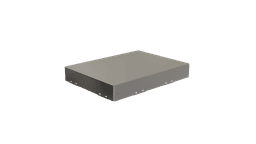
EMI Shields
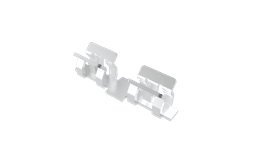
Shield Clips
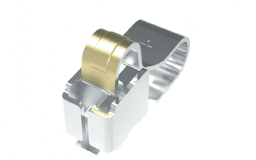
Spring Contacts

SMD PAN NUTs
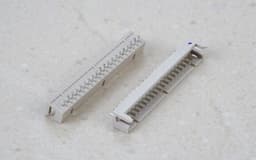
Connectors
poconsusa.com/newsletter — full archive
POCONS USA · 7750 Dagget St #208, San Diego, CA 92111