

THE SHIELD REPORT
Deep technical EMI shielding intelligence
Issue #3 · Sunday, February 15, 2026 · 6 min read
By POCONS USA — EMI shields + components. Korea → Vietnam → San Diego.
The Signal
💡 One Thing
The automotive industry's shift from 400V to 800V EV architectures doubled the DC bus voltage — but it more than doubled the EMI problem. SiC inverters switching at 20–100 kHz generate harmonic content into the hundreds of MHz. The dv/dt rates exceed 10 V/ns. Every cable, busbar, and PCB trace in the high-voltage domain is a broadband noise source. The shielding approaches that worked at 400V are insufficient at 800V. And CISPR 25 doesn't care about your voltage class — the limits are the same.
Regulatory Radar
- •
CISPR 25 Ed. 5 — vote expected Q2 2026. The IEC national committee vote on the extended frequency range (to 6 GHz) is scheduled for June. If it passes, the new edition becomes effective 12–18 months later — meaning production vehicles launched in 2028+ will need to comply. Tier 1s starting development now should design to the extended range preemptively.
- •
SAE J1113/41 — new revision for EV power electronics. SAE is revising the component-level immunity standard for HV components to address SiC-specific switching transients. The current standard's test waveforms don't capture the fast dv/dt and ringing behavior of SiC MOSFETs. Expected publication: late 2026.
- •
China GB/T 18655 update aligns with CISPR 25 Ed. 4. China's national automotive EMC standard now fully harmonizes with CISPR 25 Ed. 4, including the component-level broadband emission test method. If you're designing for Chinese OEMs (BYD, NIO, Xpeng), your CISPR 25 test report is now accepted without re-testing to GB/T 18655.
Design Corner: Shielding SiC Inverter Gate Drivers
The problem: A SiC MOSFET switching 800V at 100 kHz with a 10 V/ns slew rate generates broadband EMI from the fundamental frequency through 300+ MHz. The gate driver PCB — which sits within centimeters of the high-voltage switching node — is both a noise source (gate drive current loops) and a victim (induced noise on the isolated feedback path).
Why this is different from IGBT designs:
| Parameter | Si IGBT (400V) | SiC MOSFET (800V) |
|---|---|---|
| Switching frequency | 10–20 kHz | 20–100 kHz |
| dv/dt | 2–5 V/ns | 10–50 V/ns |
| EMI spectral content | Significant to ~30 MHz | Significant to ~300 MHz |
| Common-mode current through isolation barrier | ~10 mA peak | ~50–200 mA peak |
The isolation barrier (typically a transformer or optocoupler) between the high-side gate driver and the controller is the critical EMI path. Common-mode current driven by the SiC's dv/dt couples through the isolation barrier's parasitic capacitance (1–10 pF) and returns through the ground plane — creating a loop antenna.
Shielding approach:
- •
Shield the gate driver PCB separately from the power stage. Don't put the gate driver inside the same shielded enclosure as the SiC module. The magnetic field from the power loop will couple into the gate driver regardless of electric field shielding.
- •
Use a double-sided shield. Place a grounded copper plane on both sides of the gate driver PCB, connected by stitching vias on 2 mm centers. This creates a partial Faraday cage without a discrete shield can — critical in high-temperature environments (inverter ambient: 125–150°C) where solder joint reliability on shield cans is a concern.
- •
Ferrite sleeve on the isolation barrier. A clip-on ferrite (material: MnZn, impedance >200 Ω at 100 MHz) on the transformer primary lead adds 15–20 dB of common-mode attenuation at the frequencies where the dv/dt coupling is strongest.
- •
If a discrete shield can is required: Spec mu-metal (80% nickel) for the magnetic field component below 1 MHz, and tin-plated CRS for the electric field component above 10 MHz. In practice, a two-layer shield (mu-metal inner, CRS outer) is the gold standard for inverter gate drivers — but it costs 3–4x a single-layer CRS shield. We've only recommended the two-layer approach three times in the last year. Most automotive designs get sufficient margin with CRS alone if the ground ring and apertures are done right.
Metal Watch
| Metal | Price | Change | Outlook |
|---|---|---|---|
| Copper (Cu) | $12,310/t | ↑ 0.8% | Steady climb on AI + EV demand |
| Tin (Sn) | $48,100/t | ↑ 0.6% | Myanmar supply uncertainty |
| Nickel (Ni) | $17,580/t | ↑ 1.0% | Indonesia tax bill advancing |
Shield lead times: 4–6 weeks (standard) · 2–3 weeks (expedite)
EV-specific note: Automotive Tier 1s are requesting shield cans rated to 150°C continuous operating temperature. Standard tin-plated CRS (melting point of tin: 232°C) handles this, but the solder joint reliability at 150°C requires higher-temperature solder alloys (SAC387 or above) and tighter reflow profiles. Discuss thermal requirements with your shield supplier before layout — it affects pad design.
Field Notes
From the bench. Names changed, lessons real.
Problem: An automotive Tier 1 developing a 77 GHz corner radar module was failing CISPR 25 conducted emissions on the power supply line at 150 MHz–300 MHz. The radar's MMIC (monolithic microwave integrated circuit) operated cleanly at 77 GHz, but the DC-DC converter powering it was dumping switching noise onto the 12V supply rail.
Root cause investigation: The DC-DC converter used a 2 MHz boost topology with an inductor mounted 8 mm from the shield can wall. The inductor's fringing flux was coupling through the shield can aperture (a 3 mm cable exit for the antenna feed) and onto the power harness outside the shielded zone. Moving the inductor closer to the shield wall made it worse — the near-field coupling to the wall created eddy currents that re-radiated.
Approach: Three changes, implemented simultaneously:
- • Replaced the open aperture with a pi-filter feed-through: two 100 nF capacitors and a ferrite bead mounted directly at the shield wall penetration point.
- • Added a second shield partition wall between the DC-DC section and the RF section, with its own ground ring.
- • Moved the inductor to a position equidistant from all shield walls (centered in its compartment) to minimize near-field coupling.
Result: Conducted emissions at 150–300 MHz dropped 28 dB. The radar module passed CISPR 25 Class 5 with 9 dB margin on conducted and 7 dB on radiated. Time from failure to fix: 12 days. Shield modification cost: $0.31/unit (added partition wall + feed-through footprint).
Lesson: The radar MMIC was never the problem. The $0.60 DC-DC converter was. In mixed-signal modules, shield your noise sources first and your sensitive circuits second. The 77 GHz radio was fine — the 2 MHz power supply was the antenna.
What This Means
If you're designing for 800V SiC platforms, don't carry forward your 400V shielding approach. The dv/dt difference alone means your EMI spectral content extends 10x higher in frequency. Get the gate driver shielding right at layout — adding shields after the first CISPR 25 failure costs 6–8 weeks and a board respin.
One Thing
💡 One Thing
"At 800V and 50 V/ns, the SiC MOSFET's switching transient crosses your CISPR 25 limit in the time it takes light to travel 15 centimeters. Every centimeter of unshielded trace in the high-voltage domain is a potential emission source."
From Our Factory in Suwon, Korea
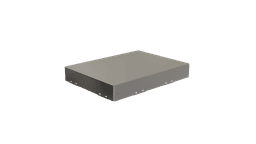
EMI Shields
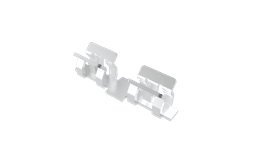
Shield Clips
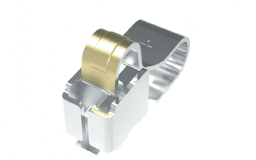
Spring Contacts

SMD PAN NUTs
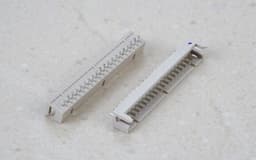
Connectors
poconsusa.com/newsletter — full archive
POCONS USA · 7750 Dagget St #208, San Diego, CA 92111