

THE SHIELD REPORT
Deep technical EMI shielding intelligence
Issue #4 · Sunday, March 15, 2026 · 7 min read
By POCONS USA — EMI shields + components. Korea → Vietnam → San Diego.
The Signal
💡 One Thing
The AI infrastructure buildout is producing hardware that violates assumptions embedded in decades of EMC engineering practice. A single GPU rack draws 57 kW. A single HBM4 stack has 12 die layers with through-silicon vias that create EMI coupling paths between memory layers. Chiplet architectures use interposer routing at pitches that make every signal trace a coupled transmission line. The textbook says "add a shield can." The textbook didn't anticipate this.
Regulatory Radar
- •
FCC Part 18 — proposed changes for wireless power transfer EMI. The FCC issued an NPRM in February to update Part 18 emission limits for wireless charging systems operating at 6.78 MHz (AirFuel standard) and 110–148.5 kHz (Qi). The proposed limits tighten harmonic emission at ISM band edges. For devices that combine wireless charging coils with board-level shields, the shield's effect on the charging coil's field pattern must be characterized — shields near WPT coils can detune the resonant frequency and shift the emission peak.
- •
IEC 61000-4-3:2024 — radiated immunity test levels updated. The latest edition increases the default test level for residential/commercial environments from 3 V/m to 10 V/m above 1 GHz. Industrial environments: 10 V/m across the full range. For products that previously passed at 3 V/m with minimal margin, this is a redesign trigger.
- •
Japan VCCI (now VCCI Council) — new voluntary emission standard for datacenter equipment. Japan's voluntary EMC body issued a draft standard for equipment operating in high-density rack environments. The standard acknowledges that individual equipment compliance doesn't guarantee system-level EMC in dense rack deployments. Recommendation: equipment manufacturers should characterize near-field emissions at 10 cm distance, not just far-field at 3 m or 10 m. This is the first standard to formally address rack-level EMI.
Design Corner: Shielding for AI Server Hardware
The context: A modern AI training rack contains 8 GPU trays, each with 8 GPUs. Each GPU has a VRM switching 100+ amps at 500 kHz–1 MHz. Each HBM4 module has a 1024-bit memory bus operating at 6.4 Gbps. The total radiated noise environment inside the rack exceeds what most commercial EMC standards were designed to test.
Three problems that don't have standard solutions:
1. Conducted EMI propagation through shared power distribution. Traditional EMC engineering treats each board as an independent unit. In an AI rack, 8 GPU boards share a common 48V power shelf. The VRM switching transients from GPU #1 propagate through the power distribution backplane into GPU #8's power input. The noise floor on the 48V bus can exceed 100 mV pp from 1–50 MHz. Individual board-level filtering helps, but the aggregate noise exceeds what standard pi-filters were designed to attenuate.
Emerging approach: Dedicated EMI shield partitions within the power distribution unit (PDU), isolating each GPU tray's power feed. Combined with common-mode chokes rated for 100A+ DC current. This is custom mechanical + electrical co-design — no off-the-shelf solution exists.
2. Package-level EMI from HBM4 stacks. HBM4 uses through-silicon vias (TSVs) connecting 12 die layers. Each TSV is a vertical conductor that couples with adjacent TSVs and the package substrate. At 6.4 Gbps per pin × 1024 pins, the aggregate switching current through the TSV array generates magnetic field emissions at the package level that propagate through the board-level shield.
The challenge: Board-level shields attenuate fields originating from outside the package. They don't attenuate fields originating from inside the package that radiate outward through the shield's interior. This is an inversion of the traditional shielding model.
Emerging approach: Package-level EMI lids — thin stamped metal or sputtered metal layers integrated into the HBM4 package substrate. Samsung and SK hynix are both evaluating this, but it adds cost and thermal complexity.
3. Chiplet interposer EMI. Multi-chiplet designs (AMD MI300X, Intel Ponte Vecchio) route signals across silicon interposers at 50–100 µm pitch. At these dimensions, adjacent signal traces have coupling coefficients >0.3 — meaning 30% of the signal energy leaks into the neighboring trace. The interposer itself becomes a radiator.
Board-level shielding over a chiplet package reduces far-field emissions but doesn't address near-field coupling to adjacent components on the same board. The shield can actually worsen the problem if its resonant frequency aligns with the interposer's dominant radiation frequency.
Practical takeaway for today: If you're designing PCBs that will operate near AI accelerator cards (networking, storage, BMC), assume the EMI environment is 20–30 dB worse than what you'd measure from your own board in isolation. We're telling every customer building for AI racks the same thing: design your filtering and shielding for the aggregate rack environment, not just your board. The ones who listen pass on the first test. The ones who don't come back in 6 weeks.
Metal Watch
| Metal | Price | Change | Outlook |
|---|---|---|---|
| Copper (Cu) | $12,280/t | ↓ 0.4% | Minor pullback, fundamentals strong |
| Tin (Sn) | $48,600/t | ↑ 1.0% | Myanmar still offline, inventories declining |
| Nickel (Ni) | $17,750/t | ↑ 0.9% | Indonesia tax expected April |
Shield lead times: 4–6 weeks (standard) · 2–3 weeks (expedite)
AI-specific note: We're seeing RFQs for shield cans with non-standard heights — 8 mm, 10 mm, 12 mm — to clear HBM4 modules and their heat sinks. Standard shield can heights (3–6 mm) don't fit the AI hardware form factor. If you're designing for AI server boards, specify shield height requirements early. Custom tooling for tall shield cans adds 1 week to the standard timeline.
Field Notes
From the bench. Names changed, lessons real.
Problem: A medical device startup was developing a continuous glucose monitor (CGM) — a wearable adhesive patch with a BLE 5.3 radio, an analog front end (AFE) for glucose sensing, and a coin cell battery. Total board area: 18 mm diameter circle. The device needed to pass IEC 60601-1-2 for radiated emissions and radiated immunity, plus maintain BLE connectivity during immunity testing.
The constraint: At 18 mm board diameter, there's no room for a traditional shield can. The tallest component (BLE module) is 2.1 mm. Total available Z-height above the board: 3.5 mm (limited by the adhesive housing). A shield can with walls, lid, and ground pads would consume 40% of the available board area.
Approach: Instead of a discrete shield can, we designed a conformal shield — a stamped nickel-silver cap (0.10 mm wall, 12 mm diameter, 2.8 mm height) that drops over the AFE section like a thimble. No solder attachment — held in place by the adhesive housing's compression. Ground contact via three spring tabs that press against exposed copper pads on the PCB.
The BLE antenna was deliberately placed outside the conformal shield, with a 3 mm keep-out zone between the shield edge and the antenna trace. The shield's geometry was tuned to avoid resonance at 2.4 GHz — the critical dimension (12 mm diameter) puts the dominant resonant mode at 12.2 GHz, well above the BLE band.
Result: Passed IEC 60601-1-2 radiated emissions with 11 dB margin. Passed radiated immunity at 10 V/m (1–6 GHz) with BLE connection maintained throughout. BLE range reduced by less than 5% compared to unshielded prototype. Shield cost: $0.18/unit at 100K volume. No solder process changes required — the shield drops in during final assembly.
Lesson: Not every shield needs solder. Not every shield needs a lid. When space is the primary constraint, conformal shields with mechanical retention can outperform traditional designs — as long as the ground contact impedance is controlled. The three spring tabs provided less than 0.5 Ω ground impedance at 2.4 GHz, which was sufficient for 40 dB SE at the BLE frequency.
What This Means
If you're building anything that goes in an AI server rack — or near one — budget for 20–30 dB more shielding than your standalone EMC test suggests you need. The GPU next to your board is a noise source your test lab didn't simulate. Talk to your shielding supplier about the rack environment, not just the board.
One Thing
💡 One Thing
"A modern AI training rack generates more broadband EMI than a 1990s cellular base station. The difference: the base station was designed to radiate. The AI rack isn't — but it does anyway."
From Our Factory in Suwon, Korea
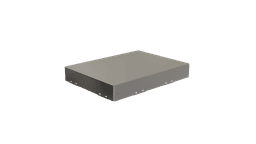
EMI Shields
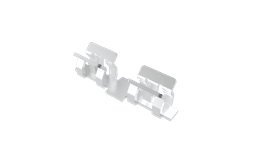
Shield Clips
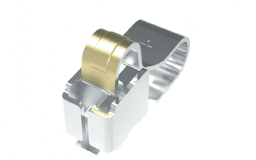
Spring Contacts

SMD PAN NUTs
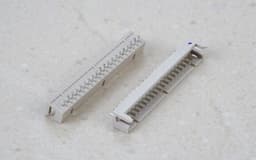
Connectors
poconsusa.com/newsletter — full archive
POCONS USA · 7750 Dagget St #208, San Diego, CA 92111